What Phlegm-Dampness Actually Is: A Spleen That Stopped Transforming
A constitution (ti zhi) is your baseline body type in Chinese medicine: the inherited and cultivated pattern of tendencies that shapes how you respond to food, weather, stress, and illness. The Phlegm-Dampness constitution is one of the nine classical types, and it's the one most tied to weight gain. The mechanism starts in the Spleen.
The Yellow Emperor's Inner Canon is explicit: the Spleen governs transformation and transportation. It turns what you eat and drink into Qi and Blood, then ships those resources through the body.
When the Spleen is strong, food becomes energy, fluids circulate, and the body stays light and clear. When it weakens, the transformation fails. Fluids no longer get fully processed; they congeal into Dampness (shi), a heavy, sticky, turbid substance TCM describes as like fog or like mud.
Dampness is the Spleen's pathological byproduct, and when it accumulates over months and years, it thickens into Phlegm (tan), a denser, more stubborn form. That's the Phlegm-Dampness constitution: a body whose fluids have partly stopped flowing and started pooling.
Modern research has started mapping this old description onto physiology. Reviews of the Phlegm-Dampness constitution have found associations with higher BMI, higher triglycerides, insulin resistance, and metabolic syndrome, and cohort studies link Dampness-related constitution scores to higher obesity risk over time. TCM didn't invent a disease here; it named a body type that modern epidemiology is rediscovering.
And the constitution isn't destiny. It's a tendency, not a sentence. The Spleen can be strengthened, the Dampness drained, and the body type transformed, which is what the rest of this article covers.
- The Phlegm-Dampness constitution is a tendency, not a diagnosis of disease. Many people with it are perfectly healthy; they just carry weight and fluid easily.
- If your tongue has a thick, greasy, pasty coating most mornings, that is the single most reliable sign you are working with Dampness.
- Dampness worsens in humid weather and with heavy, rich, sweet food. Notice how both seasons and meals affect your heaviness.
"The Spleen dislikes Dampness. When Dampness prevails, the Spleen is restrained; when the Spleen is restrained, food and drink are not transformed."
Ten Signs You're Carrying Dampness

Here are the ten signs I look for, the ten questions I ask every patient who walks in carrying weight they can't shift. One: puffiness. Your face, eyelids, or ankles look swollen, especially in the morning; rings feel tight; shoes fit better at night than at noon. That's fluid the Spleen failed to move. Two: heaviness.
Your limbs feel leaden, like sandbags strapped to your arms and legs, particularly in the afternoon and in damp weather. Three: thick tongue coating, a white or yellow greasy layer that doesn't scrape off easily. Four: greasy hair and skin, oily by evening even after washing. Five: sticky stools, soft and pasty, hard to wipe clean, sometimes floating.
Six: weight in the belly and thighs, the classic Dampness distribution, rather than even or central. Seven: morning sluggishness. You wake heavy, groggy, unrefreshed, and it takes an hour or more to feel human. Eight: brain fog, a head wrapped in cotton, concentration that's effortful, mental cloudiness that worsens after meals.
Nine: snoring, plus a feeling of phlegm in the throat you're always clearing; Dampness and Phlegm congest the airways. Ten: cystic acne or congested skin, deep sore recurring breakouts along the jawline and back, which TCM reads as Damp-Heat rising.
If six or more of these sound like you, you're almost certainly working with a Phlegm-Dampness pattern. The good news: this is one of the most responsive constitutions to treatment. When the Dampness starts to move, the heaviness, puffiness, fog, and weight begin to lift, in that order.
- Check your tongue first thing in the morning, before eating or drinking. Morning tongue is the honest tongue: thick greasy coating there is Dampness, not food debris.
- Dampness has a season: if you feel markedly heavier and foggier in humid summer weather, that is confirmation of your constitution.
- The signs cluster. If you have three or more of puffiness, sticky stools, greasy skin, and morning sluggishness, you are in Dampness territory even if you are not overweight.
"Dampness is heavy and turbid. It sinks downward, obstructs the Qi, and makes the body heavy and the mind cloudy."
How 'Dampness' Becomes Real Fat
The question patients always ask is the practical one: how does 'Dampness' become actual fat? In TCM it's a process of congealing. Dampness is fluid the Spleen couldn't transform. It isn't fat yet; it's more like sludge, water, metabolic waste, and undigested residue pooling in the tissues, which is why the Phlegm-Dampness body is puffy and soft rather than firm.
Over time, if the Spleen stays weak and the Dampness keeps accumulating, the sludge thickens. TCM calls this the transformation of Dampness into Phlegm, and the classical physicians were explicit that Phlegm isn't only the mucus you cough up. There's also 'invisible Phlegm' (yin tan) that lodges in the tissues, the channels, and the organs.
Zhu Danxi, the great Ming physician, wrote that Phlegm is the cause of a hundred diseases, and he treated Phlegm-Dampness accumulation as the underlying mechanism of obesity.
The modern reading is straightforward: a system that can't transform and transport efficiently begins to store. The metabolism slows because the system is clogged. Digestion gets sluggish, blood sugar handling weakens, lipids accumulate, and the body deposits what it can't process. That's why a Phlegm-Dampness person can eat the same calories as someone else and gain more weight.
The difference isn't willpower; it's the efficiency of transformation. And it's why targeted treatment works so well: you don't have to fight the body with ever-stricter restriction. You have to unclog it. Clear the Dampness, restore the Spleen's transforming power, and the body stops storing and starts processing again.
Patients describe it as the first time a weight approach worked with their body instead of against it. That's not a feeling. That's the mechanism working as designed.
- Think of your metabolism as a drainage system: Dampness is the clog, and every dairy latte, cold smoothie, and plate of fried food adds another layer of sludge.
- The order of improvement is predictable: heaviness lifts first, then puffiness, then brain fog, then the scale. Do not mistake a slow scale for a failed protocol.
- A 2018 review of the Phlegm-Dampness constitution found consistent links to metabolic syndrome markers; this is one TCM concept with strong modern corroboration.
"Phlegm is the cause of a hundred diseases. When Phlegm-Dampness accumulates in the flesh, the body grows heavy, and no amount of fasting can lighten it until the Phlegm is transformed."
Score Yourself: The 10-Sign Self-Test
Before we change anything, let's establish your baseline. Take the ten signs from Section 2 and score each one: 0 if it's rarely or never true, 1 if sometimes, 2 if often or always. Score how you actually are most days, not your best days. Then add the total. Zero to five means your Dampness load is mild.
You'll respond quickly to food changes alone, and you may not need the full 12-week protocol; three to four weeks of the basics, warm drinks, no dairy, a daily sweat walk, Chen Pi tea, may be enough to feel dramatically lighter.
Six to twelve means moderate Dampness. That's the majority of my patients, and the full protocol is designed for you. Expect two to four weeks before the heaviness and puffiness start to shift, and four to eight weeks before the scale moves meaningfully. Thirteen to twenty means heavy accumulation.
Your body has been storing for a long time, and unclogging takes time; commit to the full 12 weeks, ideally with a licensed TCM practitioner who can prescribe a proper formula like Er Chen Tang at a therapeutic dose, because your case merits more than kitchen herbs alone.
Retake the test every four weeks. The score is a better progress marker than the scale because it captures the things that change first: heaviness, clarity, stools, skin, energy. Patients who track the score rather than the weight are the ones who stay motivated, because they see progress in week two instead of waiting for the scale in week six.
- Retake the self-test on the same day of your cycle (for women) and at the same time of day, ideally mid-morning, so scores stay comparable.
- Take a 'before' photo of your tongue and your face. The tongue coating thinning and the face de-puffing are visible proof your protocol is working.
- A drop of even 3 to 4 points in the score by week four means the Dampness is moving, even if the scale has not budged yet.
"Measure the disease before you treat it, and measure it again after. The tongue and the pulse are the scales of the physician."
The Foods That Feed Dampness (Dairy Is Number One)
The Phlegm-Dampness constitution has a short list of enemies, and they're the foods Western nutrition would call heavy, processed, or pro-inflammatory. TCM's explanation is energetic: these foods demand more from the Spleen than it can deliver, and the unmet demand becomes Dampness. Dairy is the number one offender. Milk, cheese, ice cream, yogurt, all sweet, heavy, and phlegm-forming.
It's why so many Dampness patients describe a foggy, congested, heavy feeling after dairy that no other food produces. Cold drinks are second: every iced beverage forces the Spleen to burn energy just to warm it, and a cold Spleen transforms poorly.
Raw foods are third. Raw salads, cold smoothies, and large amounts of raw fruit ask for digestive work the Spleen can't do when it's already struggling. Sugar and refined carbs are fourth; excess sweet flavor generates Dampness and Heat directly, the exact mechanism the Inner Canon describes. Fried and greasy foods are fifth, heavy, oily, hard to transform; their grease is Dampness in food form.
Excess fruit, especially cold sweet tropical fruit in quantity or on an empty stomach, is sixth, and it surprises people. Fruit is healthy for most constitutions, but for Dampness the sugar and coldness outweigh the benefits, and a banana-and-smoothie breakfast can set the tone for a heavy day.
Beer deserves its own mention: cold, sweet, and yeasty, a triple dose of Dampness, and the classic beer belly is Phlegm-Dampness in its most literal form.
The practical rule is simple: if it's cold, sweet, greasy, raw, or milky, it feeds the Dampness. That's not a lifetime ban. It means during the 12-week protocol these foods are out, and after that they're occasional rather than daily.
- The single highest-impact swap: replace the morning smoothie or iced latte with warm congee or warm ginger tea. One swap, and the morning heaviness begins to lift within days.
- If dairy is non-negotiable for you, at least avoid it after 3 PM and never combine it with sweets: the sugar-dairy combination is the strongest Dampness trigger there is.
- Raw fruit is not forbidden; it is portioned. One piece of room-temperature fruit between meals is fine; a fruit-heavy breakfast or a cold smoothie is not.
"Sweet and fatty foods generate internal Heat; the Spleen is injured by excess sweetness, and Dampness arises from the injury."
The Foods That Drain It: A Light, Warm, Dry Kitchen
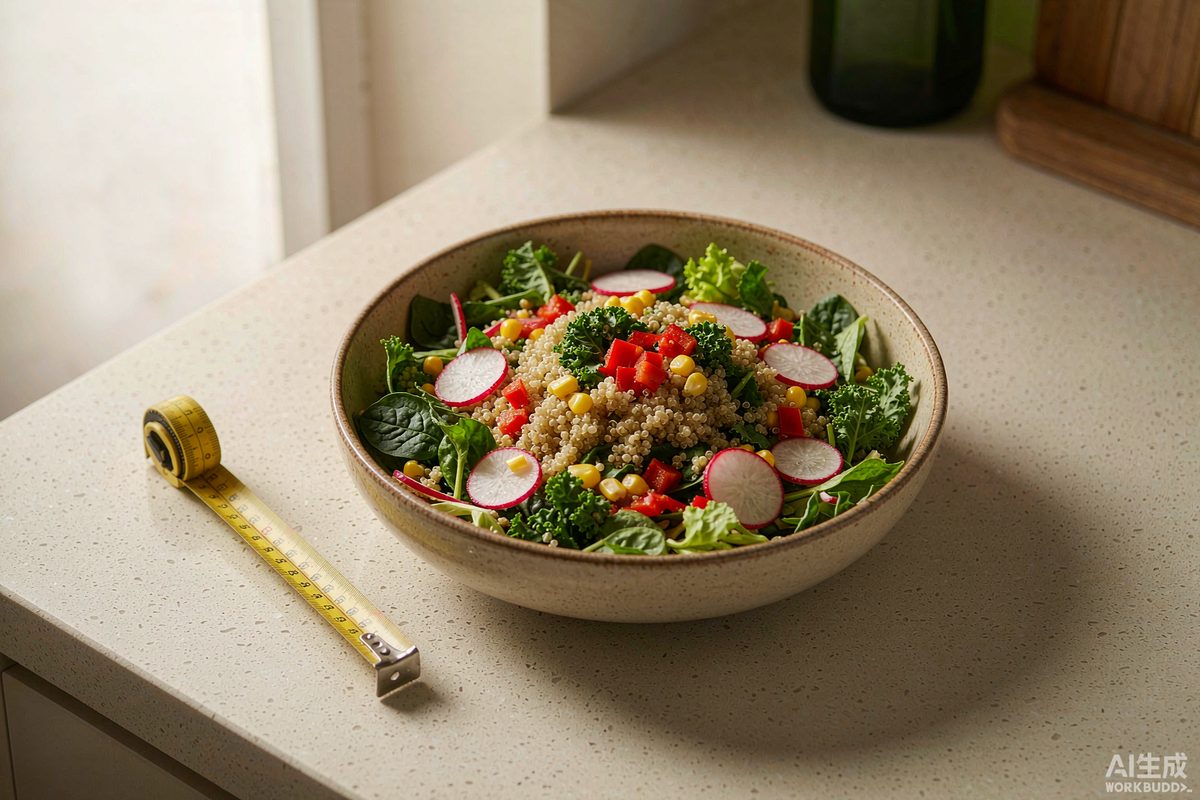
The Dampness-clearing kitchen runs on a few simple principles: light instead of heavy, cooked instead of raw, warm instead of cold, and bitter or slightly pungent flavors that dry and move. Chen Pi (aged tangerine peel) is the first pantry staple; a strip of dried peel steeped in hot water makes the signature Dampness tea, drying Dampness and regulating the Qi that moves it.
Yi Yi Ren (Job's tears, coix seed) is the second: simmer it into congee, soups, or porridge, where it drains Dampness gently while quietly strengthening the Spleen, the rare ingredient that does both. Lotus leaf (He Ye) is the third, brewed as a tea after meals to dry Dampness, clear the resulting Heat, and guide the turbidity downward, which is why it's been the traditional weight-loss tea of China for centuries.
Barley and adzuki beans are the fourth. The classic adzuki bean and Job's tears soup, lightly sweetened or drunk plain, is the most famous Dampness-draining recipe in Chinese food therapy, and barley, especially hulled, is its everyday cousin. Light soups are the fifth: winter melon, mung bean, radish, simple vegetable broths, the rinsing foods of the protocol, warm, fluid, and gently diuretic without harshness.
Ginger, scallion, and a little black pepper season everything: warm and pungent, they dry Dampness and protect the Spleen from the cooling effect of the draining foods themselves.
The Dampness kitchen isn't a deprivation kitchen. It's congee with Job's tears, lotus leaf tea after lunch, adzuki bean soup on Sunday, steamed fish with ginger, stir-fried greens with garlic, and warm water instead of cold. Patients consistently tell me the same thing: within two weeks of eating this way, the morning puffiness is gone, the heaviness has lifted, and food tastes clearer.
The body stops feeling like a swamp and starts feeling like a body.
- The classic Dampness soup: one cup adzuki beans, half cup Job's tears, simmered in 6 cups of water until soft, drunk warm across the day. Twice a week is the traditional schedule.
- Lotus leaf tea after the two biggest meals of the day is the easiest habit of the whole protocol: it is a tea, not a chore.
- Season everything with ginger, scallion, and black pepper. Warm pungent flavor is the Spleen's favorite weather, and it dries Dampness with every meal.
"Drain Dampness with what is light and dry; move it with what is warm and pungent; and protect the Spleen with what is cooked and simple."
The Herbs: Er Chen Tang and the Gentle Daily Helpers
The herbal medicine for Phlegm-Dampness has a clear hierarchy, from the classical formula down to gentle daily helpers. The classic is Er Chen Tang (Two Matured Substances Decoction), the foundational Phlegm-transforming prescription in Chinese medicine for over a thousand years.
Its core: Ban Xia (pinellia) to dry Dampness and descend rebellious Qi, Chen Pi (aged tangerine peel) to regulate Qi and dry Dampness, Fu Ling (poria) to leach Dampness out through the urine while calming the spirit, and Gan Cao (licorice) to harmonize the formula. Together they dry, move, drain, and harmonize, and Er Chen Tang, usually in modified form, remains the backbone of Phlegm-Dampness weight treatment today.
Fu Ling deserves special attention because it's both gentle and central. Neutral, sweet, entering the Spleen, it drains Dampness without injuring fluids, which makes it safe for long-term use, and pharmacological research has documented its diuretic and metabolic effects, including evidence relevant to weight management.
Yi Yi Ren is the food-grade member of the group: it drains Dampness, strengthens the Spleen, and is mild enough to eat as a grain, which is exactly how the kitchen protocol uses it.
For home use, the kitchen forms are the practical ones: Chen Pi tea, Job's tears congee, Fu Ling powder stirred into soups or congee, available as a fine white powder from TCM suppliers. For the full Er Chen Tang at therapeutic dose, work with a licensed practitioner.
The formula is safe in skilled hands, and the dose and modification should match your individual pattern, including whether Heat, Cold, or Spleen deficiency rides along. One caution covers all of this: buy herbs from reputable suppliers, and if you're pregnant, nursing, on medication, or managing a chronic condition, review any herbal protocol with your practitioner first. Herbs are medicine, even in a tea cup.
- Kitchen Er Chen Tang, the home version: simmer a strip of aged Chen Pi, a tablespoon of Fu Ling powder, and a slice of fresh ginger in two cups of water for 10 minutes. Drink warm after meals.
- Fu Ling powder dissolves easily into congee or broth and is nearly tasteless, which makes it the easiest daily herbal addition for Dampness.
- A 2017 pharmacological review of Poria (Fu Ling) documented diuretic and metabolic effects consistent with its traditional Dampness-draining role.
"Chen Pi: pungent and bitter, warm. It regulates the Qi, dries Dampness, and transforms Phlegm. Fu Ling: sweet and neutral. It leaches Dampness and strengthens the Spleen."
Three Acupressure Points: ST-40, SP-9, and CV-12
Acupuncture points are the traffic management of the body; they move Qi and fluids where they're stuck. Three points form the daily Dampness protocol, and all three are easy to reach and press yourself. ST-40 (Fenglong, 'Abundant Bulge') is the most important, the classic Phlegm-transforming point of the entire channel system, known in the classics as the point that treats abundant Phlegm anywhere in the body.
It sits on the outer front of the lower leg, halfway between kneecap and ankle, two finger-widths lateral to the shinbone, in the belly of the muscle. Press firmly with your thumb and hunt for the tender spot; hold two to three minutes. It's often noticeably sore when Dampness is high, and the soreness fades as the Dampness clears.
SP-9 (Yinlingquan, 'Yin Mound Spring') is the master point for draining Dampness. It sits just below the inner knee in the depression on the inner side of the leg, and it acts like a drain at the lowest point of the Spleen channel, pulling Dampness down and out. Press firmly for two minutes; you may feel a distinct release or a traveling sensation.
CV-12 (Zhongwan, 'Middle Cavity') sits on the midline halfway between the navel and the bottom of the breastbone. It's the meeting point of the Stomach and the front midline channel: it regulates the middle burner, supports the Spleen and Stomach in transforming food, and settles the heaviness and bloating that follow meals.
Press with the heel of your hand or two stacked fingers, breathing slowly, for two to three minutes, ideally 20 minutes after a meal.
The full daily routine runs about eight minutes: CV-12 after meals, ST-40 and SP-9 morning and evening. Do it daily for the 12 weeks, and don't be surprised if the points become less tender as the Dampness clears. That tenderness is a live meter of your progress.
- Find ST-40 by feel, not by tape measure: flex your foot and find the muscle belly on the outer lower leg, then press until you hit the tender spot. The tender spot is the point.
- Press points firmly enough to feel a dull ache, and breathe slowly while you hold. Acupressure is a two-minute meditation, not a quick poke.
- SP-9 responds to pressure with a distinctive 'release' feeling when Dampness is draining. If you feel a travel of sensation down the leg, that is the Qi moving.
"Fenglong treats abundant Phlegm: when Phlegm and Dampness fill the body, press Fenglong and the turbid Qi descends."
The 12-Week Protocol: Clear, Rebuild, Transform
Here's the complete protocol, written the way I give it to patients, in three four-week phases. Phase one, weeks 1 to 4: Clear. This phase is subtraction and drainage. Cut the Dampness feeders completely: no dairy, no cold drinks, no raw salads or cold smoothies, minimal sugar and fried food, fruit limited to one piece at room temperature.
Drink only warm liquids, Chen Pi tea after meals, lotus leaf tea after lunch and dinner. Start congee with Job's tears three or four mornings a week. Add the acupressure routine, CV-12 after meals, ST-40 and SP-9 morning and evening. Walk 30 minutes daily at a pace that makes you sweat. Expect within two weeks: a lighter feeling, less morning puffiness, a thinner tongue coating.
Phase two, weeks 5 to 8: Rebuild. Add the deeper Dampness foods: adzuki bean and Job's tears soup twice a week, winter melon or radish soup weekly, steamed fish and vegetables with ginger, congee breakfast most mornings. If you work with a practitioner, this is the phase to add a modified Er Chen Tang or a Fu Ling-rich formula at therapeutic dose.
Increase the walk to 40 minutes, add gentle strength work, squats, rows, core, twice a week, and keep the acupressure daily. Expect the scale to begin moving, typically 4 to 8 pounds, often in a sudden release around week six as retained fluid lets go.
Phase three, weeks 9 to 12: Transform. Keep the diet, add one longer weekly session, a hike, a swim, a vigorous class, to deepen the sweat work, and retake the self-test from Section 4. Most patients score 30 to 50 percent lower. Re-photograph the tongue; the thick greasy coating should be thin or gone.
From here maintenance is simple: keep the warm-liquids rule, keep congee and Job's tears in the weekly rotation, keep the Dampness teas after heavy meals, keep the daily acupressure, and let normal foods back as occasional treats rather than daily staples.
Patients who do this for 12 weeks describe the same result: the weight that took years to accumulate begins to release, energy steadies, the head clears, and for the first time a weight protocol feels like it's working with the body instead of against it.
- Track the self-test score every four weeks, not the scale every day. The score moves first and keeps you honest about progress.
- Week five to six is the classic 'release week' for Dampness: sudden diuresis, lighter feeling, and a drop on the scale. Do not change anything that week; just let it happen.
- If you plateau after week eight, the usual culprit is hidden Dampness food: sauces, dressings, cheese on the side, 'just one' cold drink. Audit, don't panic.
"Dampness is drained slowly, like wringing a wet cloth: a little each day, with warmth and movement, until the cloth is dry."