Your Body Runs a Clock — Morning Is When It Wants to Wake Up
Your body at 7 AM and your body at 7 PM are not the same machine. They run on a circadian program that Chinese medicine mapped with unsettling precision two millennia before anyone discovered the CLOCK gene.
In TCM, the day splits into twelve two-hour blocks, each governed by a different organ and its channel. The morning window that decides whether you'll feel awake or wrecked for the next sixteen hours runs from 5 AM to 9 AM. Here's the breakdown: 5-7 AM is Large Intestine time (Mao Shi) — Yang is climbing, the sun is up, your body is gearing up for elimination and alertness.
Cortisol rises naturally as part of the awakening response. You should feel awake. If you don't, your Yang isn't rising the way it's supposed to. ). Cold smoothies or no breakfast during this window directly hit Spleen Yang and set up sluggish digestion for the rest of the day.
9-11 AM is Spleen time (Si Shi) — the Spleen converts food into Qi and blood, mental clarity peaks, and this is your power window for focused work.
The core idea is simple: Yang is the active, warming, outward energy that drives everything physiological. At dawn, Yang is already ascending — like the sun clearing the horizon. Your body wants to move, eliminate, engage. Morning qigong doesn't force you awake. It just opens the gates so the rising Yang can move freely through you.
Modern chronobiology backs this up. A 2019 Sleep Medicine study found that moderate morning movement within two hours of waking improved sleep onset by about fourteen minutes and boosted sleep efficiency by 7%. The mechanism: morning light plus movement fires your suprachiasmatic nucleus — the brain's master clock — to set a strong circadian signal for the whole day.
' Your ancestors weren't more disciplined than you. They were just more aligned.
- If you wake up groggy every single morning, that's not normal — it's a sign that your Yang isn't rising adequately. This can reflect Spleen Qi deficiency (dampness weighing you down), Kidney Yang deficiency (lack of metabolic fire), or Liver Qi stagnation (energy blocked from rising). The routine below addresses all three.
- The 5-7 AM window is ideal but not mandatory. If your schedule doesn't allow it, practice as close to waking as possible. The sequence still works at 8 AM — just not quite as synergistically with the Large Intestine meridian's peak.
- Open a window or practice outside if possible. Morning Qi from fresh air directly supplements Lung Qi, which governs the body's defensive Wei Qi — your immune system's first line. Indoor, recycled AC air doesn't have the same charge.
"Yang rises at dawn and flourishes at midday. Yin rises at dusk and flourishes at midnight. The wise person arranges their activity to match the rhythm of heaven."
Coffee Borrows Energy — Qigong Makes It. Here's the Difference.

Let's be honest about the elephant in your mug. I love coffee — the smell, the ritual, that first hot sip. But the TCM take on caffeine is worth understanding before we build your morning practice, because it explains the 2 PM crash and why qigong doesn't produce one.
In TCM, caffeine 'disperses and raises Liver Yang.' It sparks a temporary upward blast of Yang — that's the alertness, the motivation, the 'I can handle my inbox' feeling twenty minutes after drinking. The problem: that Yang is borrowed. It didn't come from you.
Picture Yang as a bank account. Sleep deposits fresh Yang every night. A decent morning — gentle movement, warm food, gradual engagement — withdraws that Yang slowly and spends it across the day. Coffee? Coffee takes out a high-interest loan against tomorrow's deposit. The energy feels real, but it's pulled from deeper reserves — specifically Kidney Yang, the battery you were born with and can't refill.
Long-term heavy drinkers often develop signs of Kidney Yang deficiency: chronic low back ache, cold hands and feet, low libido, nighttime urination, a bone-deep exhaustion that sleep doesn't fix. They've been spending principal, not interest.
The afternoon crash is the bill coming due. When borrowed Yang dissipates — usually four to six hours later — the actual energy deficit underneath is revealed, and it's worse than it was before the coffee. So you drink more at 2 PM, borrow against tomorrow again, and the hole gets deeper.
Morning qigong doesn't inject Yang. It opens the routes so your own Yang can rise naturally — the way the sun clears the horizon without anyone pushing it. The energy you feel after ten minutes of qigong isn't borrowed from anywhere. It was yours already, stuck behind tight fascia, stagnant overnight Qi, compressed meridians. The movements just unlocked it.
You don't have to quit coffee entirely. I haven't. But if you can't function without it, that's not a preference — that's a dependency. And this routine is your path out.
- If you're cutting back on coffee, taper slowly over two weeks — reduce by a quarter cup every three days. Cold-turkey caffeine withdrawal can cause headaches severe enough to derail any new morning routine.
- Green tea is the TCM-approved alternative. It contains L-theanine, which promotes calm alertness without jitters, and it's classified as 'cool and clearing' rather than 'hot and dispersing.' It rises Liver Yang gently rather than blasting it skyward.
- Replace the coffee ritual, not just the caffeine. Part of coffee's hold is the warmth, the mug in your hands, the quiet moment. Warm water with lemon and ginger, sipped slowly after your qigong routine, fills the same sensory niche without the energetic debt.
"When Yang is borrowed without being restored, fire blazes without root. The flame is bright but brief, and when it extinguishes, only ashes remain."
Pre-Routine: 90 Seconds of Sensory Awakening Before Your Feet Touch the Floor
Before you stand up — before you even leave the bed — do this. It sounds weird to Western ears and it looks weirder. But these techniques wake up the cranial meridians and sensory portals that every modern morning routine ignores, and they're the difference between dragging yourself upright and actually rising.
Face tapping (30 seconds). Use the pads of all ten fingertips to tap every inch of your face — forehead, temples, cheekbones, under the eyes, along the jaw, around the mouth. Tap fast but light, like rain drumming on a roof.
You're hitting the Yang meridians that converge on the face: the Stomach channel under the eyes, the Large Intestine channel beside the nose, the Bladder channel across the forehead, the Gallbladder channel at the temples. Surface-level Qi, waking up.
Ear rubbing (20 seconds). Grab both ears between your thumbs and forefingers and rub hard — the whole external ear, lobe to helix, front and back. The ear in TCM is a map of the entire body (auricular acupuncture plots the whole organism onto the ear). Rubbing it stimulates every organ at once. You'll feel heat radiating from your ears within seconds — that's blood and Qi moving.
If your ears stay cold despite vigorous rubbing? That's a sign of Kidney Yang deficiency, and one reason you need this practice.
Tongue circling (40 seconds). Close your mouth, relax your jaw, circle your tongue against the inside of your teeth — nine times clockwise, nine counterclockwise. Swallow the saliva that builds up. This is called 'Jade Fluid Swallowing' in Daoist practice. It stimulates the Ren Mai at the palate and generates saliva — a precious Yin fluid the Kidneys produce.
Swallowing directs Kidney Yin downward and anchors the Yang you're about to raise.
Ninety seconds total. Same time as hitting snooze. But instead of fragmenting your sleep cycle and making you groggier, these three moves methodically wake your sensory nervous system, your cranial meridians, and your salivary glands. Do them sitting on the edge of the bed.
- The face tapping should feel stimulating, not painful. Light pressure, rapid tempo. Your face should feel warm and slightly tingly afterward — that's the superficial Qi moving.
- Ear rubbing generates noticeable heat within seconds. If your ears stay cold despite vigorous rubbing, that's a sign of Kidney Yang deficiency — and one of the reasons you need this practice in the first place.
- The swallowing after tongue circling is essential. Don't just spit. The Jade Fluid (saliva) is said to nourish the Stomach Yin and descend the Fire — in modern terms, it preps your digestive system for activity after the overnight fast.
"The mouth produces the Jade Fluid. When swallowed, it moistens the five organs, brightens the senses, and strengthens the body's resistance to disease. This is the first practice of the morning."
Movement 1: Shaking — The Fastest Way to Break Up Overnight Stagnation
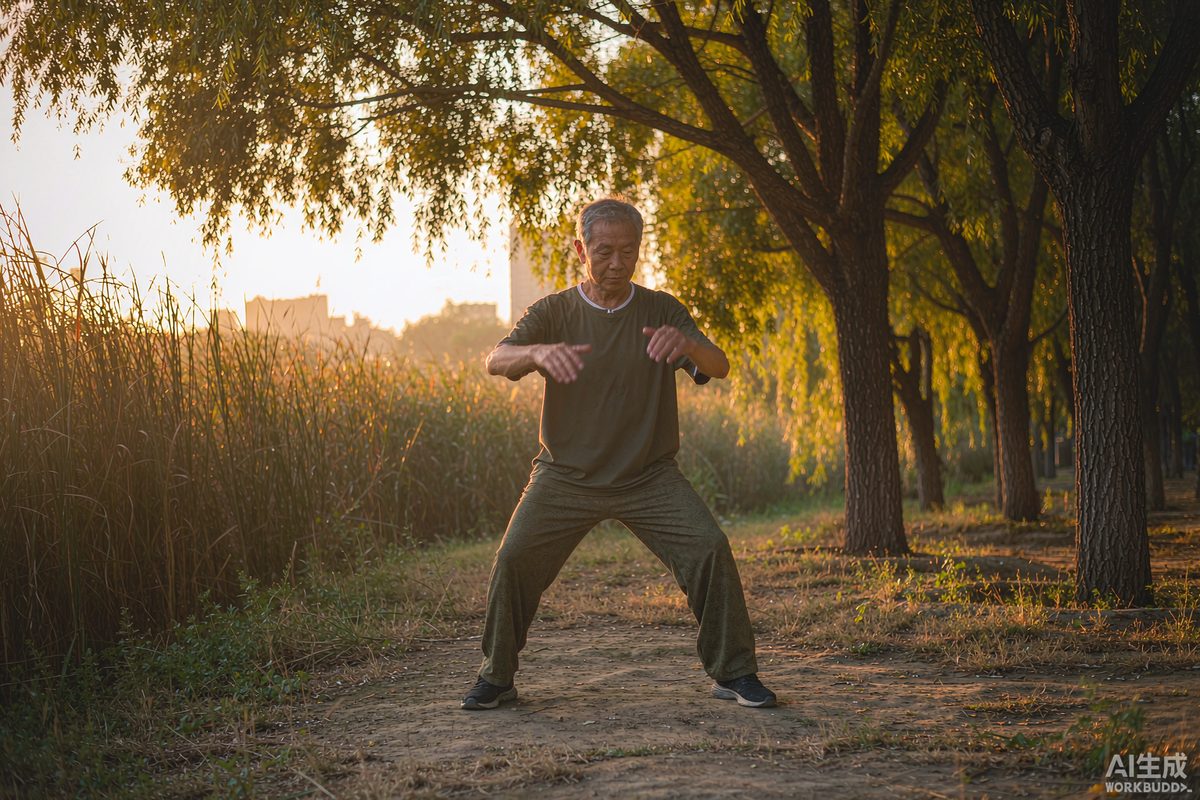
Stand with feet shoulder-width apart, knees soft. Let your arms hang at your sides like you've never used them. Now shake.
Not a seizure. A rhythmic bounce — like you're trying to shake water off your skin. Start small: just the hands and wrists. Then let the vibration move into your elbows, your shoulders, your ribcage, your spine, your pelvis. Let everything jiggle. Keep your jaw completely slack, mouth slightly open. Breathe through your nose, exhaling with a soft 'haaa' through your mouth. Two minutes.
This is the fastest way I know to release Qi that sat stagnant all night. You spent six to nine hours mostly immobile. Interstitial fluid — the stuff bathing every cell — pooled in your tissues. Fascia dried out and stiffened. The meridians, which run through and alongside fascial planes, got sluggish.
Shaking mechanically agitates every tissue layer: skin, superficial fascia, deep fascia, muscle, the lymphatic vessels that parallel the meridians. The lymphatic system has no pump — it depends on movement to circulate. After eight hours of stillness, your lymph is stagnant. Two minutes of full-body shaking pushes it through every node and vessel, clearing the metabolic waste that built up overnight.
From a TCM angle, shaking disperses stagnant Liver Qi — the trapped, frustrated energy behind morning crankiness. (You know how some people wake up angry? ) The Liver works hardest between 1-3 AM, processing emotions and detoxifying blood. If you wake up with a sour mood or a stiff body, it's often because that work got jammed.
Shaking physically wrings out the Liver channel (inner thigh, groin, ribcage) and the Gallbladder channel (side body, neck, temples), dumping the overnight accumulation.
You might feel ridiculous doing this. Good. If you feel silly, you're not clenched — and that alone releases tension your Liver has been gripping all night.
- Don't control the shaking — let it happen. The initial impulse comes from bouncing your heels, which sends a vibration up through your skeleton. From there, let your body's natural resonance take over. Different parts of your body will shake at different frequencies — that's correct.
- If you feel tightness in a specific area — say your right shoulder — let the shaking focus there. Shake INTO the tightness, not away from it. The vibration mechanically breaks up fascial adhesions.
- The slack jaw is critical. The temporomandibular joint is where the Gallbladder, Stomach, and Small Intestine meridians converge. A clenched jaw blocks all three. Let it go slack and the shaking will travel into your skull.
"Running water never stagnates. A door hinge never rusts. This is because of constant movement. The body follows the same principle — shake it daily and disease cannot settle."
Movement 2: Knocking on the Gates of Heaven — Waking Every Major Channel with Your Fists
From shaking, settle into standing. Make loose fists.
Reach your right fist across your body and knock — not with your knuckles, with the soft meaty edge of your fist (the hypothenar eminence) — against the left side of your body. Start at the top of the left shoulder (GB-21, Jian Jing, 'Shoulder Well') and knock your way down: ribs, waist, hip. Then down the outside of the left thigh, calf, and the outer edge of the foot. Switch hands and repeat on the right side.
Now knock down the front: sternum, solar plexus, abdomen, front of the thighs, shins. Then the back: reach over your shoulders and knock down your upper back, mid back, and — as far as you can reach — your lower back. About two minutes total.
You are literally percussing every major meridian. The side-body knocks hit the Gallbladder meridian — the Wood-element channel governing decision-making, courage, and the body-wide smooth flow of Qi. It's the only Yang channel that runs along the side of the body instead of the front or back, and it's the body's most complex meridian: forty-four points, multiple directional changes.
When it's congested — as it is after a night spent on one side, or from years of shoulder and neck tension — Qi everywhere becomes labored. Percussion sends vibration through the fascia encasing it.
The front-body knocks stimulate the Stomach meridian (front of the legs, abdomen) and the Ren Mai (centerline of chest and abdomen). The back-body knocks — whatever you can reach — stimulate the Bladder meridian and the Du Mai. This is full-body percussion therapy, self-administered, in two minutes. A wake-up massage you give yourself.
- Use the soft meaty edge of your fist, not your knuckles. The percussion should feel pleasantly stimulating, not painful. You're waking the meridians, not tenderizing yourself.
- On the side-body, follow the exact Gallbladder meridian path: from the top of the shoulder (GB-21), down the side of the ribs (the mid-axillary line), over the hip (GB-30, Huantiao), down the IT band (the lateral thigh), to the lateral ankle and the fourth toe.
- Spend extra time on any areas that feel dull, heavy, or tender — those are areas of Qi stagnation, and the percussion is directly breaking them up. You'll notice they become less sensitive over days of consistent practice.
"The Gallbladder is the upright official. Decisions and judgments issue from it. When the Gallbladder meridian is open, courage flows and indecision dissolves."
Movement 3: Swimming Dragon — The Spine Wave That Opens Your Yang Highway
This is the centerpiece. Stand with feet shoulder-width, knees soft, hands resting on your lower back over the Kidney region.
Now imagine your spine is a dragon swimming through water. The movement starts at your tailbone and undulates upward, vertebra by vertebra: sacrum tilts forward, lumbar curves, thoracic follows, cervical extends, head tilts back at the end of the wave. Then reverse: chin drops, cervical curls forward, thoracic rounds, lumbar flattens, tailbone tilts back.
One complete wave — front to back — takes about eight seconds. Repeat for three minutes.
Your spine has twenty-four articulating vertebrae plus the sacrum and coccyx. Modern life treats the whole thing as a rigid pole — we turn it like a log in maybe two or three segments. Swimming Dragon asks each vertebra to move in sequence, one after another, like dominoes first falling then rising.
The TCM weight behind this is huge. The Du Mai — the Governing Vessel, the Sea of Yang — runs directly along the spinous processes from coccyx to crown. When your spine is stiff, the Du Mai is constricted, and Yang can't rise to your head and senses. You get brain fog, sluggish thinking, that disconnected feeling where your head seems to float separate from your body.
Swimming Dragon mobilizes every segment, opening the Du Mai one vertebra at a time. The result: a literal wave of Yang rising from the base of the spine to the crown — the exact pathway morning coffee tries to force chemically.
There's also a purely mechanical story here. After adolescence, your spinal discs have no direct blood supply. They're nourished entirely through imbibition: rhythmic compression and decompression pumping fluid in and out of the disc matrix. Swimming Dragon, with its sequential segmental movement, is one of the few exercises that reliably hydrates intervertebral discs. Your spine literally drinks.
After eight hours of horizontal compression during sleep, this is the movement it's been waiting for.
- Initiate every wave from the tailbone — never from the head. The cervical spine (neck) is the most mobile segment and it will try to lead. Don't let it. The power comes from the sacrum, and the wave travels up, not down.
- Keep your knees soft throughout. Locked knees pin the sacrum and prevent the pelvic tilt that initiates the wave. The knees should gently bend and straighten in sync with the undulation — like shock absorbers.
- If you feel 'sticky' spots in your spine — segments that don't want to move independently — focus your breath there. Inhale into the sticky area, imagine it softening, and on the exhale, let the next wave carry through it.
"The Governing Vessel is the sea of the Yang meridians. It ascends along the spine, enters the brain, and connects with the eyes. When it is open, the mind is clear and the spirit is bright."
Movement 4: Gathering Heaven Qi — Twelve Breaths That Deliver More Oxygen Than an Hour of Shallow Breathing
The simplest movement in the sequence — and the one everyone rushes through. Don't.
Stand with feet shoulder-width, knees soft, arms at your sides. On a slow, complete inhale through the nose, sweep both arms out wide and up overhead, palms turning to face the sky as they meet above you. Your gaze follows your hands up. Eyes gently close at the top. Pause for one heartbeat — arms extended, chest open, face to the sky, receiving.
On a slow, complete exhale through the nose (or mouth with a soft 'haaa'), lower your arms down the center line of your body, palms facing downward, like you're pressing a column of energy into the ground. Your spine lengthens on the inhale, settles on the exhale. Shoulders drop away from your ears as you descend.
Twelve rounds.
The name isn't poetic. You are gathering Yang Qi from the environment. The upward arm sweep opens the Lung channel along the inner arms and the Pericardium channel along the center of the inner forearm, maximizing surface area for air and environmental Qi intake. The top-of-the-breath pause — arms overhead, chest open, face to the sky — is a postural statement to your nervous system: awake, open, receiving.
The downward press along the body's centerline traces the Ren Mai, the Sea of Yin, anchoring the Yang you've gathered into the body's structure. Without that anchor, raised Yang disperses without being stored — revving an engine in neutral.
The breath coordination is the whole point. Each inhale must be complete: lower belly, then ribs, then upper chest — a full three-part breath. Each exhale must be equally complete: upper chest to ribs to belly. Most adults breathe into the top third of their lungs, never engaging the diaphragm, never oxygenating the lower lobes where most gas exchange occurs.
Twelve conscious, full breaths — coordinated with full-body opening and closing — moves more oxygen into your blood than an hour of shallow, unconscious breathing. That's not exaggeration. That's respiratory physiology.
- The arms trace wide arcs, not narrow ones. Think of drawing a full circle with your fingertips — the wider the arc, the more you open the chest and stretch the intercostal muscles between the ribs.
- At the top, imagine you're holding a sphere of golden light between your palms. Absorb it through the Laogong points (PC-8) at the center of each palm — these are major Qi absorption points in qigong theory. Then press that golden light down through your body into the earth.
- If you feel lightheaded during the deep breathing, you're over-breathing. Slow down. Each inhale and exhale should be smooth and silent — no gasping, no forcing. The goal is relaxation, not hyperventilation.
"Heaven Qi descends and Earth Qi rises. When they meet and harmonize, the ten thousand things are born. The human being stands between heaven and earth, receiving and transforming both."
Movement 5: Patting the Meridians — Two Minutes of Self-Massage Along Every Channel
The last active movement. Open palms — not fists — and a steady, rhythmic pat. You're going to work your way through every major meridian highway in the body.
Start with the inner arms (Lung, Pericardium, Heart): pat from the chest down the inner bicep, past the inner elbow, down the inner forearm, to the wrist and palm. Then the outer arms (Large Intestine, Triple Burner, Small Intestine): pat from the back of the hand up the outer forearm, past the outer elbow, up the outer bicep, to the shoulder.
Now the legs: pat down the inner legs (Liver, Kidney, Spleen) from the groin to the ankle, then up the outer legs (Gallbladder, Stomach, Bladder) from the ankle to the hip.
Now the torso: pat the chest, then the abdomen in clockwise circles — following the Large Intestine path: up the right side, across the top, down the left side. Finish with both palms patting the lower back (the Kidney region). About two minutes.
This is absurdly simple. Which is exactly why people skip it, and exactly why it works so well. Rhythmic open-palm percussion stimulates the cutaneous branches of every major meridian — the nerve endings and micro-vessels in the skin that form the meridian system's most superficial layer. Think of it as tapping a kinked garden hose: vibration travels through the fluid column and releases the obstruction.
Direction counts. Pat downward along the Yin meridians (chest to hand, groin to foot) — that follows the natural flow of Yin. Pat upward along the Yang meridians (hand to shoulder, foot to hip) — that follows the natural flow of Yang. You're not randomly slapping yourself. You're reinforcing the body's fundamental polarity: Yin sinking, Yang rising.
By the end, everything should feel warm, tingling, and awake — a full-body massage compressed into 120 seconds.
- Use full, open palms — not cupped hands (which just makes noise) and not stiff hands (which hurt). The palm should be relaxed and slightly hollow, creating a resonant thump rather than a sharp slap.
- The abdominal patting should follow the exact path of the Large Intestine: up the right side of the abdomen, across the top (below the ribs), down the left side. This is the direction of peristalsis and promotes morning bowel movement — which is exactly what the Large Intestine meridian governs during its 5-7 AM peak.
- Spend extra time on the lower back patting — this is the Kidney region and the Ming Men (Gate of Life). Percussion here stimulates Kidney Yang, which is the root of all Yang energy in the body. If your lower back feels cold to the touch, pat longer.
"The meridians are the rivers of the body. When they run clear and unobstructed, the hundred diseases cannot arise. Pat them daily as you would clear a channel of fallen leaves."
The Full Morning Sequence, From Bed to Fully Awake
Here's your morning, structured. No decisions. No scrolling for the right video. Just this.
Minute 0-1.5: Pre-routine (in bed or on the edge). Face tapping (30 sec), ear rubbing (20 sec), tongue circling with Jade Fluid swallow (40 sec). Your senses are online and your mouth isn't dry.
Minute 1.5-3.5: Shaking. Stand up, feet shoulder-width, shake everything. Let your jaw hang. Feel the overnight stagnation break up.
Minute 3.5-5.5: Knocking on the Gates of Heaven. Loose fists — sides (Gallbladder), front (Stomach, Ren Mai), back (Bladder, Du Mai). Two minutes of full-body percussion.
Minute 5.5-8.5: Swimming Dragon. Hands on your lower back, undulate your spine vertebra by vertebra. Three minutes of spinal wave that opens the Du Mai and hydrates your discs.
Minute 8.5-10: Gathering Heaven Qi. Twelve full breaths, wide arm arcs. Inhale rising, exhale sinking. The oxygen surge plus the postural signal: awake, open, receiving.
Minute 10-12: Patting the Meridians. Two minutes of rhythmic open-palm percussion down Yin, up Yang, reinforcing energy polarity. Warm, tingling, activated.
Minute 12-12.5: Closing. Stand still. Hands over the lower Dantian, eyes closed. Three deep belly breaths. Feel the energy you've generated — not borrowed, not forced — circulating through you.
Open your eyes. Done. Twelve and a half minutes. No coffee, no cold shower, no Instagram. You moved in sync with your own circadian program, and your body responded the way two thousand years of practice said it would: by waking up.
First week: do the full sequence and track your energy at 10 AM, 2 PM, and 6 PM on a simple 1-10 scale. Most people see real improvement by day five, with peak benefits around day fourteen. If you're pressed for time, the minimum effective dose is Pre-Routine + Shaking + Gathering Heaven Qi (roughly five minutes). But the full twelve-minute sequence is where the sustained morning energy lives.
- The first week: do the full sequence once and notice how you feel at 10 AM, 2 PM, and 6 PM. Track your energy on a simple 1-10 scale. Most people see significant improvement by Day 5, with peak benefits around Day 14.
- If you're really pressed for time, the minimum effective dose is the Pre-Routine + Shaking + Gathering Heaven Qi (about 5 minutes total). But the full 12-minute sequence is the sweet spot for sustained morning energy.
- Combine with warm water (never cold or iced) after the sequence. Warm water supports Spleen Yang and prepares the digestive system for your first meal. Cold water contracts the Stomach meridian and dampens the digestive fire you just spent twelve minutes kindling.
"The sage does not treat those who are already sick, but those who are not yet sick. The sage does not govern what is already in chaos, but what is not yet in chaos. The highest medicine is prevention, and the highest prevention is daily practice."