Meet the General: Why Your Liver Is in Charge of Your Thinking
The Yellow Emperor's Inner Canon organizes the body like a government, and every organ gets a job. The Heart is the sovereign. The Lungs are the prime minister. The Spleen runs the granary. And the Liver? The Liver is the general. 'The Liver is the general of the organs,' says Suwen Chapter 8. 'Planning and deliberation issue from it.'
Two thousand years later, that metaphor turns out to be neurologically on-target. The Liver governs the free flow of Qi — the smooth movement of energy, blood, and emotion through every channel. When that flow is free, your thinking is free: decisions come easily, frustration dissipates, your view stays wide.
When Liver Qi stagnates — blocked by stress, suppressed anger, resentment, deadlines, the grinding pressure of ordinary life — the general's strategy room goes dark. Thinking narrows. Decisions feel impossible. Small irritations detonate. And sleep gets punctured at the most telling hour of the night: 1-3 AM, the Liver's own watch.
Modern neuroscience calls this cluster emotional dysregulation, cognitive rigidity, stress-induced executive dysfunction. TCM calls the mechanism Gan Qi Yu Jie — Liver Qi Stagnation.
This article maps the axis between the two: how the state of your Liver channel shapes the state of your mind, the six signs that a stagnant Liver is clouding your thinking, and the three-front protocol — herbs, acupressure, emotional release — that gets the strategy room lit again.
- Notice your body before your mood: tension in the sides of the ribs, a tight jaw, a knot in the throat — these are the physical signatures of Liver Qi Stagnation.
- Track when your worst decisions happen. Stagnant-Liver decision-making peaks under time pressure and emotional load, not when you're calm.
- If your anger feels 'stuck' — building for days without a release — that is Liver Qi accumulating. Release it deliberately, not reactively.
"The Liver is the general of the organs. Planning and deliberation issue from it. When the Liver's Qi is free-flowing, the hundred functions are orderly. When it stagnates, the hundred emotions are disturbed."
What a Blocked Liver Does to a Working Brain

Here's the clinical bridge between the two traditions. The Liver channel runs through the torso, the head, the eyes, and the sinews — but its reach is wider than its anatomical path. Because the Liver governs the free flow of Qi everywhere, a stagnant Liver throttles the whole system: blood circulation, nervous system tone, digestive motility, and the brain.
In TCM, the Liver stores the Blood and houses the Hun, the Ethereal Soul — the part of you that dreams, imagines, and holds the big picture. Lingshu Chapter 8 says that when the Liver is obstructed, the Hun cannot move freely. The result: tunnel vision, loss of imagination, repetitive worry loops, a mind that circles the same problem without ever arriving.
Now translate that into neuroscience. Chronic emotional suppression activates the amygdala and keeps the prefrontal cortex — the seat of executive function and cognitive flexibility — partly inhibited. Anger narrows attention; that's documented. Induced anger reduces working memory capacity and biases decision-making toward risk.
Hold in frustration for weeks and your brain runs a permanent stress subroutine in the background, burning the metabolic resources the prefrontal cortex needs for clear thinking.
The result is the stagnant-Liver mental state: thoughts moving through syrup. You re-read the same email four times. You defer decisions. You snap at people and regret it instantly. That's not a personality flaw. It's an organ state — Liver Qi Stagnation — expressing itself as cognitive dysfunction.
- Notice the quality of your attention, not just your mood: repetitive worry loops and an inability to 'let a thing go' are Hun-restriction symptoms.
- Decisions made while angry or frustrated are systematically worse — research shows anger biases risk assessment. Defer big decisions until the Liver Qi moves.
- If you feel physically tense in the ribcage and mentally stuck at the same time, treat them as one problem. They are.
"The Liver stores the Blood and houses the Hun. When the Blood is replete and the Liver Qi flows freely, the Hun dwells peacefully and the spirit is expansive. When the Liver is obstructed, the Hun is confined and the mind is narrow."
Six Signs Your Thinking Is Being Clouded by a Stagnant Liver
Liver Qi Stagnation never announces itself as 'your Liver is blocked.' It shows up as a pattern of mental and physical symptoms that most people misread as stress, personality, or bad luck. Here are the six — and if you recognize four or more, your thinking is probably being clouded by a stagnant Liver.
Irritability. The short fuse. Fine one moment, explosive the next, usually over small things. It's the most common emotional expression of Liver Qi Stagnation, because the Liver's emotion is anger, and blocked anger leaks out as general volatility.
Indecision. The general can't strategize. You defer, you overthink, you collect opinions you don't use. Decisions that should take minutes take days.
Tunnel vision. One solution, one interpretation, one path. The big picture — the Hun's specialty — has collapsed to a narrow corridor.
The 1-3 AM waking. You fall asleep fine, then wake between 1 and 3 AM with a racing, looping mind. The Liver meridian peaks during those two hours, and stagnant Qi surges against the blockage.
Sighing. You catch yourself sighing — a deep, involuntary exhale — repeatedly. TCM reads this precisely: the body is trying to move stuck Liver Qi with each sigh.
Throat tightness. A lump in the throat that won't swallow away. The classic 'plum-pit Qi' (Mei He Qi) of Liver Qi Stagnation rising upward.
Each sign maps onto a mechanism: blocked movement (sighing, throat), blocked emotion (irritability), blocked cognition (indecision, tunnel vision). Treat the blockage and the whole cluster loosens. I've watched it happen enough times to trust the pattern.
- Rate yourself on the six signs weekly. Improvement should be visible within 2-4 weeks of an active protocol — that's your objective feedback loop.
- The sighing and throat tightness are the body's own attempts to move Liver Qi. When you notice them, stop and do three slow, full exhales deliberately.
- Don't diagnose yourself with 'just stress.' The pattern is specific, and the treatment is specific to the Liver channel.
"When Qi stagnates, the hundred diseases arise. Where there is obstruction, there is discomfort; where there is movement, there is ease. The plum-pit Qi in the throat is Qi that has lost its freedom to flow."
The 1-3 AM Wake-Up Call Nobody Wants
Of all the signs, the 1-3 AM waking is the one patients find most eerie — and it's the one with the clearest TCM mechanism. Chinese medicine divides the day into twelve two-hour watches, each governed by an organ meridian. The Liver rules 1-3 AM; its paired organ, the Gallbladder, rules 11 PM-1 AM.
The theory: during the Liver's watch, its Qi is at peak activity, processing the day's blood, emotions, and accumulated stress. In a healthy person, this happens silently — you sleep through it. In a person with Liver Qi Stagnation, the Qi surges against its blockage exactly at the Liver's peak hour, and the surge is strong enough to wake you.
The waking is rarely gentle. You don't drift up; you snap awake, often with a racing mind, replaying the very frustrations you suppressed during the day. It's the Liver's alarm clock going off — the backlog of unprocessed emotion is now too large to be processed in silence.
Here's the encouraging part: the waking is a signal, not a sentence. When patients move the stagnant Qi — the emotional release protocol below, herbs, acupressure — the 1-3 AM waking is typically one of the first symptoms to resolve, often within one to three weeks.
If you wake at 1-3 AM, don't reach for your phone. That floods the Liver watch with light and stimulation and deepens the stagnation. Instead, press LV-3 and GB-34 — both are in the acupressure section below — for three minutes, breathe slowly, and let yourself drift back. The goal is to help the Liver finish its night shift instead of fighting it.
- If you wake at 1-3 AM, resist all screens. Light during the Liver watch tells the brain it's daytime and deepens the stagnation.
- Keep an acupressure tool or your own thumbs ready: three minutes on LV-3 (Taichong) at the 1-3 AM waking can break the loop and return you to sleep.
- A consistent bedtime before 11 PM matters more than total hours for Liver patients — it lets the Gallbladder-Liver transition begin without resistance.
"The Liver Qi surges at the hour of Chou (1-3 AM). When the Liver is in harmony, this is the hour of deepest repair. When the Liver Qi is bound, this is the hour of waking, anxiety, and racing thought."
Herbs That Unstick Liver Qi: From Xiao Yao San to Rose Tea
The herbal strategy for a stagnant Liver is called Shu Gan Jie Yu — 'soothe the Liver and resolve depression,' where depression means stagnation, not necessarily a clinical mood disorder. The herbs in this category have one job: restore the free flow of Qi.
The flagship formula is Xiao Yao San, the 'Free and Easy Powder,' composed in the Song dynasty and still the most-prescribed Liver-moving formula in the world. Its genius is balance. Chai Hu (Bupleurum), the sovereign herb, enters the Liver and Gallbladder channels and disperses stagnation like wind clearing fog. Bai Shao (White Peony) nourishes Liver Blood so the dispersing doesn't over-dry.
Dang Gui (Angelica) and Bai Zhu (Atractylodes) build the Blood and Qi that give the Liver something healthy to circulate. Bo He (Mint) and Sheng Jiang (Ginger) carry the Qi upward and outward. The result: the stagnation moves, the emotion releases, and the mind widens.
A 2017 meta-analysis of randomized trials found Xiao Yao San significantly superior to placebo for depression and anxiety — modern evidence for a thousand-year-old formula.
If you're not ready for a formula, single herbs do the same job at lower intensity. Chai Hu is the master mover, best in small doses and usually paired with a nourishing herb. Xiang Fu (Cyperus) is called the 'general of the Qi medicines' — the most powerful single herb for breaking up stagnant Qi in the chest and under the ribs.
Mei Gui Hua, rose flower, is the gentle mover: it soothes the Liver, moves Qi, and calms the spirit at once, which makes it perfect for the irritable-but-sensitive patient, and it's delicious as tea.
One caution, and it's a real one: Liver-moving herbs are dispersing, and dispersing without nourishing can exhaust an already-deficient Liver. If you feel depleted and foggy as well as tense, see a licensed herbalist who can build a formula that moves and nourishes at the same time.
- Rose flower (Mei Gui Hua) tea is the gentlest entry point — drink it in the afternoon when the day's frustrations are accumulating.
- Xiao Yao San is best taken for 4-8 weeks at a time, then reassessed. It's a course of treatment, not a daily supplement forever.
- Liver-moving herbs work best when taken with a walk or stretch — the movement physically assists the Qi dispersal.
"Chai Hu is the medicine that raises the clear and disperses the stagnant. It enters the Liver and Gallbladder, and when the pivot of the Shao Yang turns freely, the hundred joints and the mind are both unblocked."
Three Points to Press When You Can Feel the Knot
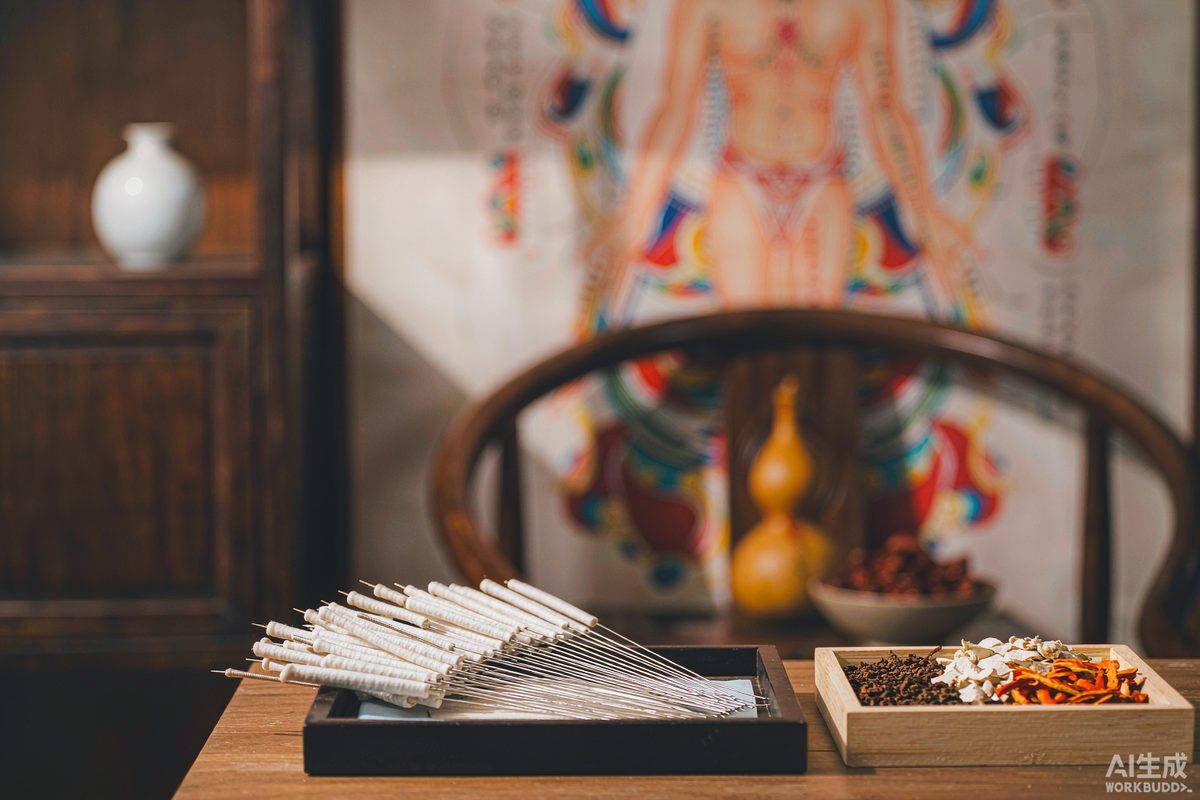
Acupressure on the Liver channel gives you a portable release valve — usable at your desk, in traffic, or in the middle of the 1-3 AM waking. Three points carry most of the clinical weight.
LV-3 (Taichong, 'Great Surge') is the master point for moving Liver Qi: on top of the foot, in the depression between the big toe and second toe, about two finger-widths back from the web. It's the point acupuncturists reach for first with anger, irritability, and stress.
Press firmly with your thumb — you should feel a deep, almost toothache-like sensation — and hold for two to three minutes per foot while breathing slowly.
GB-34 (Yanglingquan, 'Yang Mound Spring') is the influential point of the sinews, on the outer lower leg in the depression just below and in front of the head of the fibula. It relaxes the physical tightness of stagnation — the clenched jaw, the tight neck, the rib tension — and it's the classic pairing with LV-3 for moving the Liver and relaxing the sinews.
LV-14 (Qimen, 'Cyclic Gate') sits on the chest wall directly below the nipple, in the sixth intercostal space, roughly at the level of the lower ribs. It's the Liver's Mu, or alarm, point — the place where stagnant Liver Qi physically accumulates. If pressing under your right ribcage hurts, that tenderness is diagnostic: the stagnation is gathering there.
Use the pads of two fingers to press firmly into it for two to three minutes, breathing into it.
A full Liver-moving session takes about ten minutes: LV-3 bilaterally, GB-34 bilaterally, LV-14 on the tender side. Do it in the evening, ideally between 7 and 9 PM. The effect is a deep physical release that supports both mood and sleep.
- LV-3 is the point to press the moment you feel irritability rising — before the explosion, not after.
- If pressing LV-14 is painful, that's diagnostic: the tenderness itself confirms the stagnation is gathering there.
- For the 1-3 AM waking: LV-3 + GB-34 for three minutes, slow exhales, no light. This is the single most effective self-treatment for the Liver alarm clock.
"Taichong (LV-3) is the Earth point of the Liver channel and the great point for calming the Liver and subduing Yang. When pressed, the rebellious Qi descends and the spirit is restored to peace."
The Venting Ritual, the Side Stretch, and the Sixty-Second Decision
Herbs and points move the Qi, but if the emotion keeps accumulating at the same rate, the stagnation rebuilds. The third front is structural: give your stuck emotions a regular, deliberate exit. This is the protocol I give every stagnant-Liver patient, and it has four components.
The venting ritual. Every evening — ten minutes, same time, ideally 7-9 PM — write out everything you suppressed that day: the annoyance at your coworker, the email you didn't send, the decision you're avoiding. Don't edit, don't censor, don't aim for quality. The research on expressive writing shows measurable reductions in anger, stress physiology, and even inflammatory markers.
This is emotional excretion, and the page is the toilet. I tell patients that exact sentence, and the ones who actually do it come back with the same report: it works, and it's uncomfortable, and both things are true.
Movement that opens the sides. The Liver channel runs along the flanks, and side-opening movement physically unkinks it: side bends, torso twists, the 'reaching for the moon' stretch, any lateral yoga flow. Ten minutes of it after the venting ritual multiplies both effects.
Sour foods. The sour flavor enters the Liver and assists its governing function of gathering and freeing. A squeeze of lemon in warm water, a sour plum drink (Suan Mei Tang), vinegar dressings — small daily sourness supports the Liver's free flow. Not constant lemon water; excess sour over-constricts. Moderation is the point.
The decision-making practice. Stagnant-Liver patients avoid decisions, and avoiding decisions deepens the stagnation. The practice: every day, make one small decision on purpose, and fast. What to eat, which route to walk, which email to answer first. Decide in under sixty seconds and don't revisit. It rebuilds the general's atrophied strategy muscle, one small campaign at a time.
Run all four daily for four weeks, and the pattern breaks: the irritability softens, the indecision thins, and the 1-3 AM waking usually fades.
- The venting ritual works only if it's private and unfiltered — the moment you censor yourself, the excretion stops being excretion.
- Side bends and twists are the Liver-specific movement: rotate your torso with arms out and you'll feel the exact route of the Liver channel opening.
- Sour foods are therapeutic in the morning and evening, not a license for constant lemon water — excess sour over-constricts. Moderation is the point.
"The wise man releases what he feels at the moment he feels it, so that nothing is stored to obstruct the Qi. The unwise man stores, and storage becomes stagnation, and stagnation becomes disease."
The Line Between Stagnation and Depression — and How to Know Which Side You're On
There's a line between Liver Qi Stagnation — a functional blockage that responds beautifully to herbs, acupressure, and release — and clinical depression, which is a medical condition requiring professional treatment. Where you stand on that line matters more than any self-treatment in this article.
Seek professional help if: the low mood has lasted more than two weeks; you've lost interest in things you used to love; your sleep has collapsed beyond the 1-3 AM waking — early waking that never improves, or sleeping twelve hours and still exhausted; your appetite has swung dramatically in either direction; you feel hopeless, worthless, or like a burden; or you have any thought of self-harm.
In that last case, contact a crisis line or your physician today — not after finishing the article.
Here's the honest clinical picture. The classic pattern of Liver Qi Stagnation and the early stages of depression share symptoms: irritability, sleep disruption, decision paralysis, tunnel vision. That overlap is exactly why the TCM framework is useful — it gives a coherent model of the functional stage, when the blockage is still reversible with lifestyle, herbs, and emotional work.
But if the pattern has deepened — if the fog has turned to flatness, if the irritability has turned to numbness — you need the full toolkit: psychotherapy, possibly medication, and ideally a TCM practitioner who works alongside your physician.
These are not competing systems. CBT restructures the thought patterns; Xiao Yao San moves the Qi underneath them; acupressure gives you a self-soothing tool between sessions. The most effective depression care I've seen integrates all of it. My CEO patient didn't stop therapy when his sleep cleared — he kept both tracks running. The Liver doesn't get 'fixed' forever.
It gets maintained: free flow is a practice, not a cure. The general keeps planning. You just have to keep the strategy room clear.
- Use the two-week rule: transient irritability is stagnation; a flat, hopeless, interest-less two weeks is a signal to get evaluated.
- If you're already in therapy or on medication, add TCM as a complementary layer — and tell all your providers what you're taking. Herbs and meds can interact.
- Crisis resources exist and work. If you're having thoughts of self-harm, call your local crisis line or 988 (US) — and let someone you trust know tonight.
"The superior physician treats the spirit first, the body second. For when the spirit is bound, no medicine can be fully effective; and when the spirit moves freely, half the healing is already done."