The Belly That Won't Budge Is Often a Meridian Problem, Not a Muscle Problem
Every weight-loss clinic has that one patient. The person who loses weight everywhere except the middle — face slims, arms slim, thighs slim, and the belly just sits there, soft and unmoved, like it's holding a grudge.
Western fitness hands them a plan: more crunches. Planks, Russian twists, the whole ab circuit. The assumption is that a belly is a muscle problem, and if you train the muscle hard enough, the fat has to give. After fifteen years of treating weight patients, I can tell you that assumption fails for a large fraction of them.
The belly that won't move is often not a muscle problem at all. It's a meridian problem — specifically, a problem of the Dai Mai, the Belt Vessel, the only horizontal meridian in the entire body. Patients look at me funny when I say this, so let me slow down and draw the map.
Chinese medicine describes the body as a network of vertical channels: twelve primary meridians running up and down, carrying Qi and Blood through the limbs and trunk. Vertical lines need something horizontal to bind them — a belt. That's the Dai Mai's job. It circles the waist like a sash, and the Nan Jing (Classic of Difficulties) states its function plainly: to 'bind and connect all the channels.'
Think of it as the tension ring of the body. A healthy Dai Mai holds the vertical channels snug against the torso, the way a belt holds trousers up. Organs stay supported, Qi circulates, fluids move. When the belt slackens, everything sags — organs sit lower, circulation through the trunk weakens, and fluids pool in the abdomen the way water collects in a sagging tarp.
That pooled fluid, mixed with the metabolic leftovers of a sluggish Spleen, becomes what TCM calls Dampness and Phlegm. And Damp-Phlegm in the abdomen is precisely the soft, puffy, stubborn belly that laughs at crunches. The modern literature says something compatible: waist circumference predicts metabolic risk better than BMI, and visceral fat behaves differently from subcutaneous fat.
The meridian framework reads the same observation from the inside — the belly isn't storage, it's a drainage problem.
So the fix isn't more crunches. It's re-tightening the belt — with patting, twisting, and breathing that re-engage the Dai Mai and give the pooled Dampness a way out. That's the rest of this article, and it costs about five minutes a day.
- Before you add a single crunch to your routine, measure your waist at the navel line and write it down. This practice is measured in inches, not reps.
- Ask yourself the Dampness question: is your belly soft, puffy, and indented by tight clothing (Dampness), or firm and muscular underneath a fat layer (a different problem)? The Dai Mai practice targets the first.
- The scale is the wrong instrument for this work. Water shifts, muscle changes, and day-to-day noise will hide your progress; the tape measure at the navel line will not.
"The Dai Mai binds all the channels like a belt. When the belt is loose, the hundred vessels sag, and Dampness pools in the middle like water in a valley."
Where the Belt Actually Runs: Finding the Dai Mai and GB-26 on Your Body

To work with the Belt Vessel you first need to find it. The Dai Mai originates at the level of the kidneys, emerges at the free ends of the ribs, and circles the waist in a full horizontal ring — from the spine, around both sides, back to the navel.
Its classical point is GB-26, called Dai Mai, literally 'Belt Vessel.' It sits on the side of the waist, directly below the free end of the eleventh rib, level with the navel. Roughly four finger-widths out from the navel, at the narrowest part of the waist — about where the side of a belt buckle would sit. Put your hands on your waist with thumbs pointing back, and the point is right there in the soft hollow.
Two more points continue the ring: GB-27 and GB-28 run slightly lower toward the front. The whole horizontal band — navel to spine, both sides — is Dai Mai territory. You don't need to memorize numbers. You need one image: a belt line at navel height, all the way around.
In classical acupuncture the Dai Mai belongs to the Eight Extraordinary Vessels, a deeper, more structural system than the twelve organ meridians. The extraordinary vessels act as the body's reservoirs and frameworks. The Ren Mai runs up the front midline, the Du Mai up the back, the Chong Mai through the center — all vertical.
The Dai Mai is the exception: the single horizontal member, and the only one that binds the verticals together.
Yang Jizhou's Zhen Jiu Da Cheng, the great Ming acupuncture classic, treats the Dai Mai as central to anything involving the waist and lower abdomen: slackness, heaviness, swelling, that 'water-bag' feeling in the lower trunk. The clinical logic is elegant — if the belt is loose, tighten the belt. Acupuncture at GB-26 tonifies the Dai Mai directly.
But you don't need needles to reach it. The patting, twisting, and breathing practices below stimulate the same territory, and you do them daily, which is more than most patients get from weekly acupuncture. The anatomy gives you a target: one horizontal ring at navel level. Every practice in this article works that ring.
- Find GB-26 on yourself: place your thumb at your navel, extend your hand sideways — the point is where your index finger lands on the side of the waist, in the soft hollow at the narrowest part.
- Mark the belt line on your skin mentally, or actually trace it with your finger: from the spine at waist level, around both sides, to the navel. That entire circle is your practice target.
- The belt line is not the hip bone line. It sits at the level of the navel — the narrowest part of your waist — not down at the iliac crest.
"The eight extraordinary vessels are the reservoirs of the channels; among them, only the Dai Mai runs horizontally, binding the vertical rivers so they do not overflow their banks."
Three Things Slacken the Belt: Childbirth, Sitting, and a Tired Spleen
The Belt Vessel doesn't slacken at random. Three causes dominate in my clinic, and between them they explain most stubborn bellies.
Childbirth, first. Pregnancy stretches the abdominal wall and the fascial structures of the waist for nine months, and the Dai Mai — the tension ring — takes the brunt. After delivery, many women find the belly never quite returns, no matter how many crunches they do. That's not a muscle failure alone; the belt's resting tension has dropped, and the vertical channels no longer hug the trunk.
The classical texts recognized this: a stretched, weakened lower abdomen leaves the Dai Mai slack, and the treatment is to re-tighten the ring.
Second, prolonged sitting. This is the modern epidemic. Eight to ten hours a day in a chair shortens the hip flexors, switches off the deep core stabilizers, and lets the abdomen slump forward — the belt line goes slack. The body adapts to the position it's held in most; a body held in a seated slump adapts to a slack waist.
The transverse abdominis, the deepest abdominal muscle and a natural corset, stops firing after hours in a chair, and its resting tension drops.
Third, chronic Spleen weakness. In TCM the Spleen governs transformation and transportation: it turns food into Qi and moves fluids through the body. A weak Spleen — from irregular meals, too much cold and raw food, sugar, chronic stress — fails to move fluids, and they accumulate as Dampness. Dampness is heavy, and heaviness settles in the lowest, most dependent part of the trunk: the abdomen.
Now stack the three. A slack belt plus a weak Spleen equals fluid pooling in a sagging structure. The Dampness makes the belly soft and puffy; the slack belt means nothing is moving it out; the weak Spleen keeps producing it. That's why this belly is characteristically soft and indentable — it's as much retained fluid and Phlegm-Damp as fat tissue. You can press a finger into it and leave a dent.
And it's why crunches fail. Crunches train the rectus abdominis, the six-pack muscle, which does almost nothing for the deep belt ring or for moving Dampness. You can have a strong rectus and a slack belt at the same time — that's the 'hard over soft' belly some people describe.
The fix has to work all three levels: re-tighten the ring (patting, twisting), re-engage the deep core (breathing), and cut the Dampness supply (diet). That's the full protocol, below.
- If you sit for work, stand up and circle your waist (the twisting practice below) for one minute every hour. The belt line re-tightens when you remind it it exists.
- For postpartum bellies specifically: start with the breathing practice before any patting, and go gently. The tissues need re-engagement before they need stimulation.
- Ask yourself what feeds your Dampness: dairy, cold drinks, sugar, and late heavy meals are the four biggest producers. Reduce them and the belly has less water to pool.
"The Spleen governs transformation and transportation. When it is weak, fluids congeal into Dampness; and Dampness, being heavy, settles in the middle like silt in a slow river."
Practice 1: Pat the Belt Line — 100 Pats, About Two Minutes

This is the signature practice of the Belt Vessel tradition, and it's deceptively simple: pat the entire waistline circle with your palms, one hundred times. Here's the exact technique.
Stand with feet shoulder-width apart, knees soft, spine long. Use open palms and the heel of the hand, relaxed — the strike should be a springy slap, not a hard blow. Start at the sides of the waist, at GB-26, the narrowest part level with the navel, and work around the full circle: sides first, then the lower back over the kidneys, then around to the front over the lower abdomen, and back around.
The rhythm is one pat per second, alternating hands, wrists loose. You're aiming for a firm, resonant thump you can feel through to the inside of the abdomen — not a painful impact. One hundred pats around the full belt line takes about two minutes. Patients often describe the right sound as a hollow 'pok.'
The intention matters as much as the mechanics. Patting (pai da) is a classical method for moving stagnant Qi and Blood and shaking loose accumulated Dampness. Each pat sends a small mechanical wave through the abdominal tissues and along the meridian line, waking the deep fascia and signaling the body to move pooled fluid.
It's the same principle as tapping a clogged pipe to get the water moving — gentle, rhythmic, persistent.
Patients report sensations in sequence: first surface warmth, then a deeper internal warmth spreading through the abdomen, and — in those with genuine Dampness — an urge to urinate or pass gas within the hour. That's the body moving the fluid the patting loosened.
When to do it: daily, ideally morning before breakfast or evening before bed, when the abdomen is relaxed. Consistency beats intensity — 100 pats every day for three months changes the waistline; 500 pats once a week does almost nothing.
A word on safety: pat only soft tissue, never the spine, never an area of pain or injury, never hard enough to bruise. After abdominal surgery, pregnancy, or hernia repair, get clearance from your surgeon or physician first, and start feather-light. If patting the abdomen feels wrong for you, the twisting practice in the next section is a gentler entry point.
- Count out loud or in sets of 25 — 25 on the right side, 25 on the left, 25 on the back, 25 on the front. The structure makes the 100 easy to complete.
- Relax the wrist completely. A tense, hard slap is wrong; a springy, resonant thump that echoes inside the abdomen is right. You should hear a hollow 'pok' sound.
- Do it before meals, not right after. Patting on a full stomach is uncomfortable and less effective; the empty morning abdomen is the ideal canvas.
"Pat the hundred vessels and the Qi moves; pat the belt line and the Dampness flows downward like water finding its way out of a field."
Practice 2: Twist the Waist — Wringing Out the Midsection
The second practice is the waist twist — Niu Yao in Chinese — and the image is exactly right: you're wringing out the midsection like a wet towel, squeezing pooled Dampness out of the tissues so circulation can carry it away.
The technique: stand with feet slightly wider than shoulder-width, knees soft. Hands on hips or hanging loose. Rotate the upper body from the waist — not the hips, not the shoulders — in a slow, full horizontal circle: forward to the right, around the back, to the left, and forward again. The head stays relatively level; the rotation comes from the waist.
The range should be comfortable but real — you should feel the twist through the sides of the waist and the lower back, the exact territory of the Dai Mai. Twenty full circles in one direction, then twenty in the other, slowly, breathing evenly. Total time: two to three minutes.
The classical logic mirrors the patting but works differently. Where patting stimulates, twisting wrings. The rotation compresses and releases the abdominal contents rhythmically — organs, fascia, fluid spaces — mechanically squeezing stagnant fluid out of the tissues and into circulation and lymphatics, where it can be processed and eliminated.
It also stretches and strengthens the obliques, the diagonal muscles that wrap the waist and partner the Dai Mai ring.
In classical practice, waist twisting is prescribed specifically for 'Dampness in the middle burner' — the heavy, bloated, sluggish-abdomen pattern — and for the stagnation that follows long sitting.
The twist is also where TCM and modern exercise science shake hands: rotational core training is standard in functional fitness, and the obliques it trains are exactly the muscles that pull the waistline in from the sides.
Do the twist after the patting, or on its own if patting isn't for you. Want more? Clasp your hands in front of your chest and twist with a gentle side-to-side swing, letting the arms follow the momentum — that turns the practice into a small aerobic movement. Slow and deep or swinging, the rule is the same: rotation from the waist, even breath, pain-free range.
- Imagine you are wringing out a towel that hangs from your ribcage down to your hips. The squeeze-and-release feeling in the abdomen is the practice working.
- Go slow enough that you can feel each vertebra and each side of the waist participate. Fast, sloppy twisting is cardio; slow, deep twisting is the medicine.
- Synchronize the breath: inhale as you rotate through the front, exhale as you rotate through the back. The exhale is when the Dampness 'squeezes out.'
"Twist the waist like wringing a cloth, and the turbid Dampness is pressed out of the middle; the clear Qi rises, the turbid descends, and the belly lightens."
Practice 3: Breathe Into the Lower Belly — Re-Engaging the Deep Corset
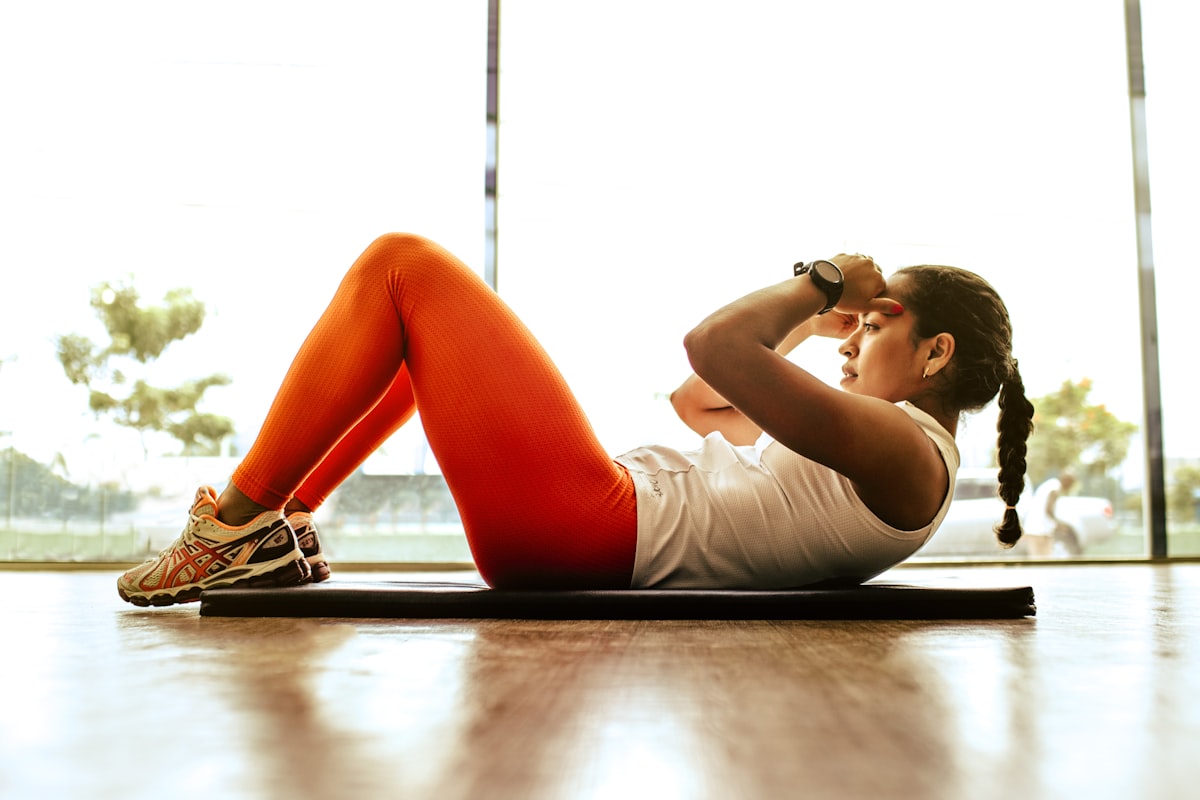
The third practice is the one that makes the other two stick: diaphragmatic breathing into the lower abdomen. Its job is to re-engage the transverse abdominis — the deepest layer of the abdominal wall, the muscle that wraps the waist like a natural corset and is, in a real sense, the muscular expression of the Dai Mai.
Here's why it matters. The transverse abdominis is not a movement muscle; it's a tension muscle. It fires when you brace, when you exhale forcefully, and it's the muscle that holds the abdomen in. When it's weak or switched off, the abdomen sags forward and the waistline widens even without added fat. ' And the most reliable way to activate it is not a crunch — it's a breath.
The technique: lie on your back with knees bent and feet flat, or sit upright in a chair with a long spine. Place one hand on your lower abdomen, just below the navel. Inhale slowly through the nose and let the breath drop into the lower abdomen — the hand rises as the diaphragm descends and the belly expands, soft and wide, like a balloon filling.
Then exhale slowly through the mouth, and here's the key: on the exhale, gently draw the navel in toward the spine, as if pulling your belly button to the back of your waist. Imagine zipping up a tight pair of jeans — the lower abdomen hollows and flattens, and you feel a deep corset-like tension wrap around the waist at belt level. Hold that draw for a second at the end of the exhale, release, and inhale again.
Ten to fifteen slow cycles, two to three minutes total, once or twice daily. Each exhale-draw re-engages the deep corset; over weeks the resting tension of that muscle rises, and the abdomen stays held in even when you're not thinking about it.
The classical tradition added something else. Breathing into the lower abdomen massages the internal organs with the diaphragm's movement, which improves the movement of fluids and Qi in the middle burner — the water the belt is supposed to keep moving. Do this practice after patting and twisting, or as a standalone several times a day. It's invisible, silent, and works at a desk.
It's also the safest entry point for postpartum patients, whose tissues need gentle re-engagement before stimulation.
- Test yourself: exhale fully, then try to puff your belly out while keeping the breath out. If you cannot hold it out, your transverse abdominis is working — that is the draw you are training.
- The 'zip-up' cue works better than 'suck in': you are not vacuuming the gut up under the ribs; you are drawing the navel horizontally back toward the spine, at belt level.
- Do five cycles every time you sit down to eat. The deep corset engaged before a meal supports digestion and subtly reduces the 'food baby' bloat after.
"Breathe to the navel and the Qi returns to its root; when the Qi returns to its root, the hundred vessels are bound and the middle is held firm."
What Makes the Practices Stick: Food, Acupressure, Posture, Warmth
The three practices are the core, but the Belt Vessel work succeeds or fails on the supporting factors. If the Dampness supply isn't reduced, you're bailing water from a boat with a hole in it.
First, the Damp-clearing diet. The biggest Dampness producers are dairy — especially cold dairy — cold and iced drinks, sugar, refined carbs, fried food, and excess fruit. All of it burdens the Spleen's transformation and adds fluid to the pool. The foods that dry and move: barley, adzuki beans, winter melon, radish, celery, lotus root, Chinese yam, cooked leafy greens, and ginger in everything.
Warm drinks only — every cold drink asks the Spleen to burn energy warming it, and a cold, tired Spleen makes more Dampness. The daily rule in four words: warm, cooked, light, low-sugar.
Second, GB-26 acupressure. The classical point of the Belt Vessel — side of the waist, level with the navel, four finger-widths out, in the soft hollow at the narrowest part — responds well to firm, sustained pressure. Press both sides at once with your thumbs or middle fingers, breathing slowly, one to two minutes, twice daily. Right after patting is ideal. Most patients feel a spreading warmth along the belt line.
Third, posture. The belt line lives or dies by how you hold your trunk during the day. Slump, and the abdomen folds and the waist ring goes slack. Sit tall with the crown of the head lifted and the pelvis neutral, and the belt line holds its tension. The single most powerful habit: every hour of sitting, stand, put your hands on your lower back, arch backward gently three times, then circle the waist a few times.
Fourth, movement that involves the waist: walking with a relaxed, swinging trunk, dancing, tai chi's waist-led movements — anything that rotates the midsection works the Dai Mai territory. The classical Daoist exercises (Dao Yin) are full of waist circles precisely because the tradition identified the waist as the hinge of the whole body.
Finally, warmth. A warm waist is a mobile waist. A hot shower aimed at the lower back, a warm compress on the abdomen, a few minutes of moxibustion along the belt line — all support the Spleen and Kidney Yang that keep fluids moving. Cold waist, stagnant fluids; warm waist, moving fluids. That's the whole physiology in one sentence.
- The 80/20 Damp rule: eat Damp-clearing foods 80 percent of the time and the Dampness production drops enough for the practices to win. Perfection is not required.
- Press GB-26 while you watch TV: two thumbs on the side-waist points, one minute per side, and you have done a full week's worth of point work without noticing.
- Put a visual cue at your desk — a sticky note at eye level saying 'LONG SPINE.' Posture is a habit, and habits need reminders for the first month.
"The waist is the pivot of the hundred bones. When the pivot turns freely, the Qi of the whole body turns with it; when the pivot rusts, everything above and below suffers."
The Honest Timeline: Feelings First, Clothes Second, Tape Measure Third
Let me give you the honest timeline, because the marketing world has trained us to expect a flat stomach in two weeks, and this practice does not work that way.
Weeks 1 to 2 are the feeling phase. Not much moves on the tape measure, but you'll feel things: warmth along the belt line after patting, a lighter, less bloated abdomen after meals, better digestion, and — in Damp-heavy patients — more urination and clearer bowel movements as the pooled fluid starts moving. This is the bailing phase. The practices are moving Dampness out, and the body is eliminating it.
Weeks 3 to 6 are the transition phase. Clothes start to feel different at the waist. The soft, puffy quality of the belly begins to change — firmer, less 'watery,' less indentable. The tape may show half an inch to an inch. This is the re-tensioning phase: the transverse abdominis is re-engaging, the belt line is tightening, the Dampness load is visibly down.
If you're also following the Damp-clearing diet, this is when changes accelerate.
Months 2 to 3 are the visible phase. This is where the two-to-three-inch reduction becomes realistic — not from the practices alone, but from the full protocol: patting, twisting, breathing daily, plus the diet, plus posture and movement habits. The navel-line measurement is the honest metric, and it moves in the right direction for most patients who stay consistent.
What you won't see: spot reduction in weeks, dramatic scale changes (the scale is noisy with water), or a six-pack — this is not bodybuilding. What you'll see, in order: less bloating, a firmer abdomen, a smaller waist, then the belly fat itself slowly reducing.
The deeper point: the Dai Mai work isn't cosmetic. The waistline it tightens is the metabolic waistline — the circumference modern medicine links to visceral fat and metabolic risk. Every inch off the belt line is an inch off the metabolic danger zone. That's the real reason to do this.
And the final honest note: consistency is everything. Five minutes a day, every day, beats an hour once a week. The belt re-tightens through daily small tension, not weekly big effort. Set the alarm, stand up, pat, twist, breathe, measure once a week. In three months the tape measure will tell you the truth — and it'll be good news.
- Measure at the navel line, same time of day, once a week — and write it down. The tape measure is the only honest scoreboard for this game.
- Expect the order of changes: feelings first (weeks 1-2), clothes second (weeks 3-6), tape measure third (months 2-3). Do not quit in phase one because phase three has not arrived.
- Photograph your waist from the side monthly. The tape measure catches the inches; the photo catches the posture and firmness changes that numbers miss.
"The sage does not seek quick results, for the body changes like the seasons: the seed must root before the stem rises, and the stem must rise before the fruit forms."